AI Agents vs.
Chatbots
A chatbot answers questions. An AI agent takes actions — reading your inbox, extracting data from PDFs, updating your accounting software, and flagging what needs a human. We build the second kind, because that's where the hours actually get saved.
We design and ship AI agents scoped to one real job — sorting purchase order emails, extracting line items from invoices, drafting replies, or reconciling data between two systems that don't talk to each other. No generic "AI strategy" decks, just a working agent tied to an outcome you can measure.
Built on GPT-4 / Claude / Groq depending on latency and cost needs, with a classifier and extraction layer in front so the agent only acts on what it's confident about — everything else gets routed to a human.
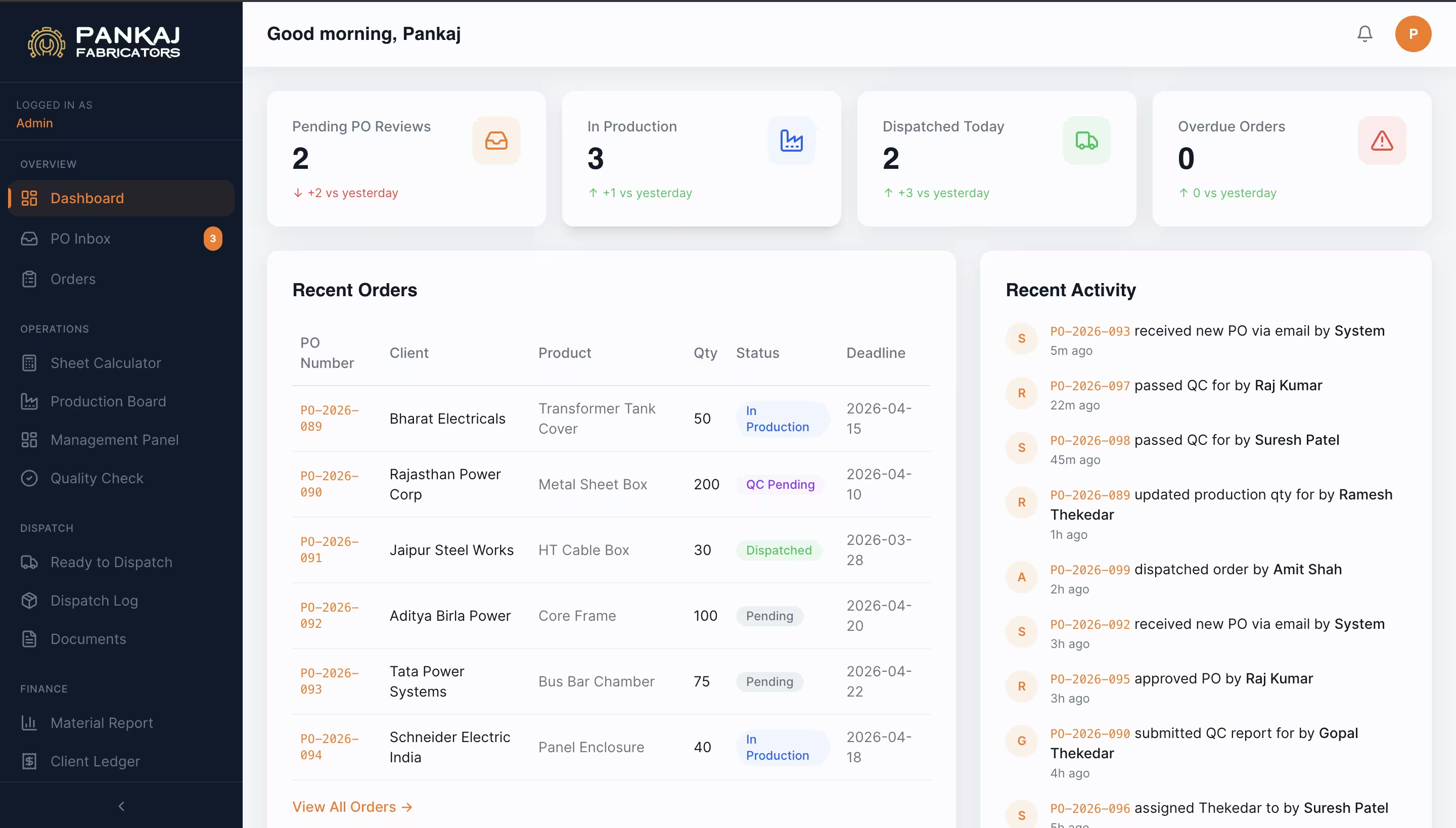
Gmail/Outlook API monitoring that classifies incoming mail, an AI extraction layer that pulls structured data out of unstructured PDFs, and a write-back step into Tally, your CRM, or a dashboard — no manual re-typing.
This is the exact pipeline we built for a ₹60Cr Jaipur manufacturer supplying BHEL and Crompton Greaves — eliminating manual purchase-order entry entirely.
Knowledge-grounded support agents that answer strictly from your documents, help center, or product docs — never from general training data, so there's no risk of a confident wrong answer reaching a customer.
We productized this as Minyut, our own embeddable RAG chatbot — live on a client's site in about two minutes with a single script tag.
Agents that sit between your existing tools — triggered by a new row, email, or webhook — to summarize, calculate, generate documents, or push updates into dashboards your team already checks daily.
We build these as narrow, auditable pipelines rather than open-ended "autonomous" agents, because in production, predictable beats clever.
Agents that read untrusted input (emails, uploaded files, scraped web pages) are a prompt-injection risk by default. We scope tool access tightly, sanitize inputs, and — where it matters — run requests through ekmire, our own developer security platform built specifically to catch prompt injection and MCP tool poisoning.
Most agencies bolt AI onto a website. We build the guardrails first, because we build our own security tooling in-house.
Indicative pricing
for
AI agent projects
Scoped by the number of systems the agent touches and how
much judgment it needs to exercise.
Every engagement starts with a short discovery call to confirm
the agent is solving a real bottleneck — not just adding AI for its own sake.
Prices are indicative; actual cost depends on integrations and volume.
Single-Task Agent
One System Integration
A focused agent for one job — classifying emails, extracting data from a fixed document format, or drafting responses from a template.
Document & Email Pipeline
2-3 System Integration
Gmail/Outlook monitoring, PDF extraction, and write-back into your accounting software or CRM — the Pankaj Fabricators pattern.
RAG Support Agent
Custom Knowledge Base
A support agent trained strictly on your documents, deployed as an embeddable widget, with escalation to a human for anything it isn't confident about.
Multi-Agent Operations
Full-Stack Deployment
Multiple coordinated agents across your operations stack, with dashboards, audit logs, and security guardrails built in from day one.
One pipeline.
Zero manual entry.
For a 47-year-old precision manufacturer supplying BHEL, Crompton Greaves, and Thales Portugal, we replaced hours of daily manual purchase-order entry with a Gmail API + AI extraction + Tally pipeline — with full order and revenue visibility in a live dashboard.
Read the full case study