A Dashboard vs.
a Bigger Team
Most operational bottlenecks don't need more headcount — they need the three people already doing the work to stop fighting the same Excel file. We build the system that replaces the spreadsheet, not another hire to manage it.
A single live view of orders, inventory, or revenue instead of five people editing five different sheets. Built around the numbers you already check daily — no retraining your team on a new tool they'll abandon in a month.
This is the pattern behind the 3-panel dashboard we built for a ₹60Cr/year fabrication company — full order and revenue visibility, replacing what used to live across inboxes and spreadsheets.
Gmail/Outlook monitoring, AI extraction from PDFs and invoices, and a write-back step into Tally, your CRM, or a dashboard — eliminating the manual re-typing that eats hours every week and loses POs in someone's inbox.
Automations that trigger on a new row, email, or webhook — calculating raw material needs, generating documents, or pushing updates into the tools your team already checks. Narrow, auditable, and built around the specific bottleneck we find, not a generic "automation platform" subscription.
Connecting the accounting software, CRM, and website you already use so data stops living in five places at once. See API Development for the integration layer that makes this possible.
A system that breaks silently is worse than the spreadsheet it replaced. We monitor what we build and keep it working after launch — not a one-time handoff.
Indicative pricing
for
automation projects
Scoped by the number of systems involved and how much
manual work is being replaced.
Every engagement starts with a short discovery call to confirm
we're fixing the actual bottleneck — not just adding a dashboard for its own sake.
Prices are indicative; actual cost depends on integrations and volume.
Single Workflow Automation
One Process
One repetitive process automated end to end — a calculation, a document generation step, or a data sync between two tools.
Operations Dashboard
2-3 System Integration
A live dashboard pulling from the tools you already use — the Pankaj Fabricators pattern, scaled to your data sources.
Multi-System Operations Platform
Full Deployment
Document pipelines, dashboards, and integrations across your full operations stack, with monitoring built in.
One dashboard.
Zero manual entry.
For a 47-year-old precision manufacturer supplying BHEL, Crompton Greaves, and Thales Portugal, we replaced hours of daily manual purchase-order entry with a Gmail API + AI extraction + Tally pipeline — with full order and revenue visibility in a live dashboard.
Read the full case study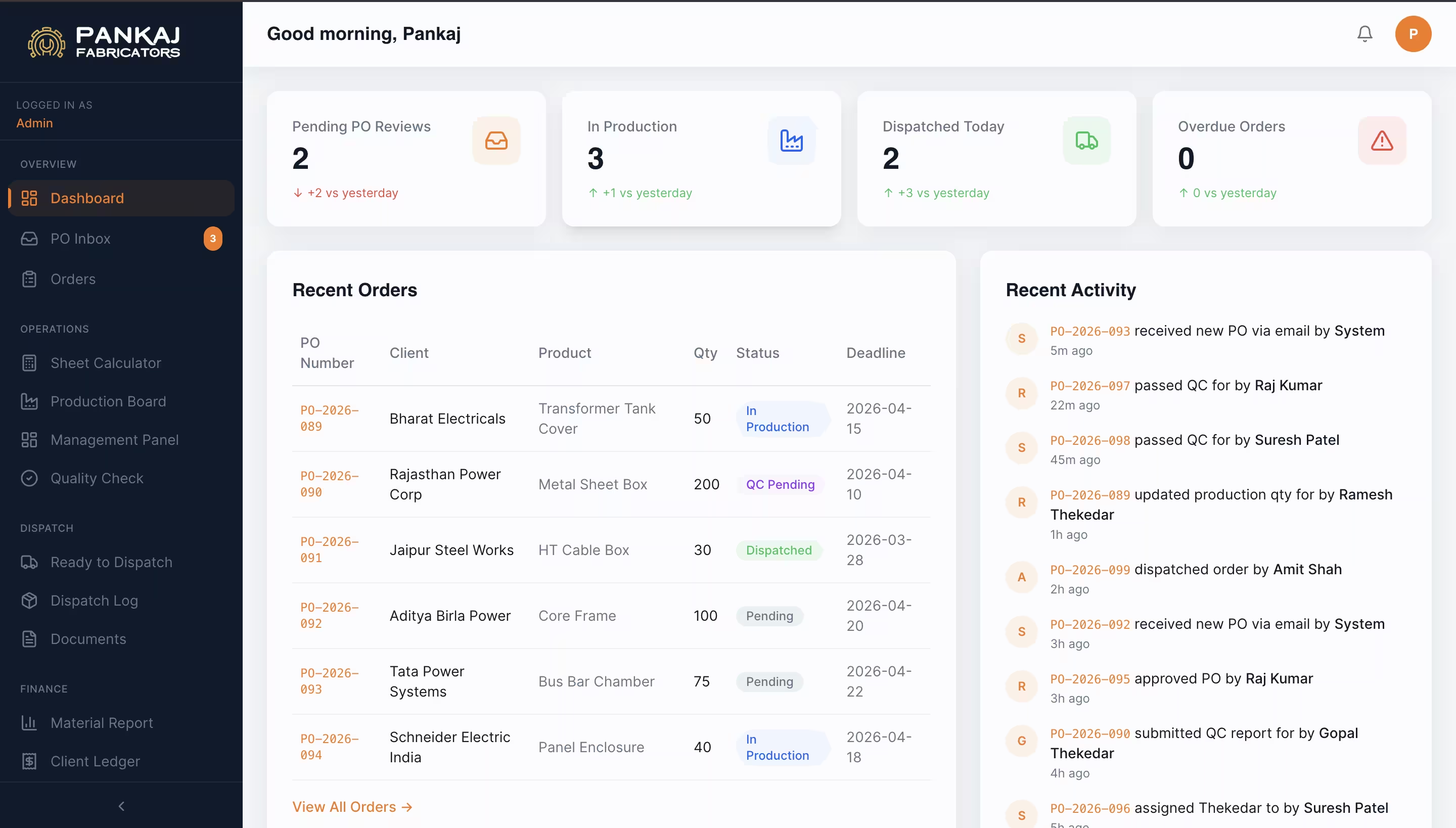
Business automation, plainly explained
What counts as "business process automation"?
Any repeatable task currently done by a person copying data between an inbox, a spreadsheet, and an accounting tool. If three people touch the same file to keep it updated, that's usually a sign it can be automated.
How is this different from just hiring more staff?
Hiring adds capacity to the same broken process. Automation removes the manual step entirely, so the process doesn't need more hands — it needs less friction.
Do we need to replace our existing tools (Tally, Excel, our CRM)?
Usually not. Most of what we build sits on top of or connects between the tools you already use — the goal is to stop the manual re-entry, not to force a migration.
How long does a typical automation project take?
A single workflow automation usually ships in 2-4 weeks. A full operations dashboard with multiple integrations runs 6-10 weeks, depending on how many systems it touches.